
Stop calling it teambuilding!
Discover why confusing team building with incentive events can lead teams into the wrong terrain. Learn the importance of clear distinctions for effective team dynamics and successful outcomes.
Jef Lercher Verstraeten
1/30/20265 min read
in many organizations, team building and incentive events are treated as interchangeable. They appear on the same slides, are booked with similar budgets, with the same organisers and often take place in similar destinations. Yet in practice, they serve fundamentally different purposes.
In the mountains, confusing these two would be like mistaking a rope-training day for a summit celebration. Both happen at altitude. Both can be memorable. But apply the wrong approach at the wrong moment and the outcome is disappointing at best—and risky at worst.
Understanding the difference is not a semantic exercise.
It is a leadership decision.
Semantics matter (more than most leaders admit)
At the semantic level, the distinction is already clear. A team is not simply a group of people spending time together. It is a group working toward the same why and the same goal. Building that team means actively working on how people collaborate under pressure—clarifying roles, strengthening communication, aligning decision-making. That work is real work. It is rarely effortless, and it is not always comfortable. If done right, a team-building will be fun at times, but that is a by-product.
An incentive, by contrast, exists to incentivise. A company car. A Rolex. Stock options. Or, in this context, an event. Its purpose is not to improve how a team functions, but to reward behavior and performance that have already taken place. Enjoyment or fun is the main goal here, with improved connection between co-workers a potential by-product.
Confusing the two turns development into entertainment—and recognition into an intervention it was never meant to be.
1. The core difference: intention and timing
At their heart, team building and incentive events differ in why they are organized and when they take place.
Team building
Team building exists to improve how a group functions. It focuses on collaboration, communication, decision-making, trust, and role clarity. It is most effective when a team is entering a new phase: a new project, a new composition, a new leader, or a period of increased complexity.
Success is not measured by how enjoyable the experience felt in the moment, but by whether the team works better afterwards—weeks and months later.
Incentive events
Incentives are about recognition and reward. They take place after performance has been delivered. Their function is to acknowledge achievement, strengthen emotional connection to the organization, and reinforce motivation for the future.
Success here is measured emotionally: appreciation, pride, loyalty, and shared memory.
Alpine translation
Team building is the preparation before a glacier crossing: checking knots, agreeing on commands, clarifying who leads and who observes.
An incentive is the dinner at the hut after the crossing—because the team earned it.
2. Why organizations often get it wrong
Many companies organize what they call a “team building” event while subconsciously hoping it will fix deeper collaboration issues—without ever naming them. Others plan an incentive, but quietly expect it to resolve tensions or misalignment
This mismatch creates predictable problems.
Wrong expectations
If people expect to be rewarded and instead find themselves in reflective sessions, motivation drops.
If they expect real issues to be addressed and instead get a purely recreational experience, cynicism grows.
Wrong intervention
Research on team effectiveness consistently shows that teams improve most when interventions focus on clear goals, role clarity, communication patterns, and psychological safety. Fun alone does not create alignment. Structure does.
Alpine translation
A rope team that struggles with pace, communication, or decision-making will not improve simply because the view is beautiful. The view matters—but only after the fundamentals are in place.
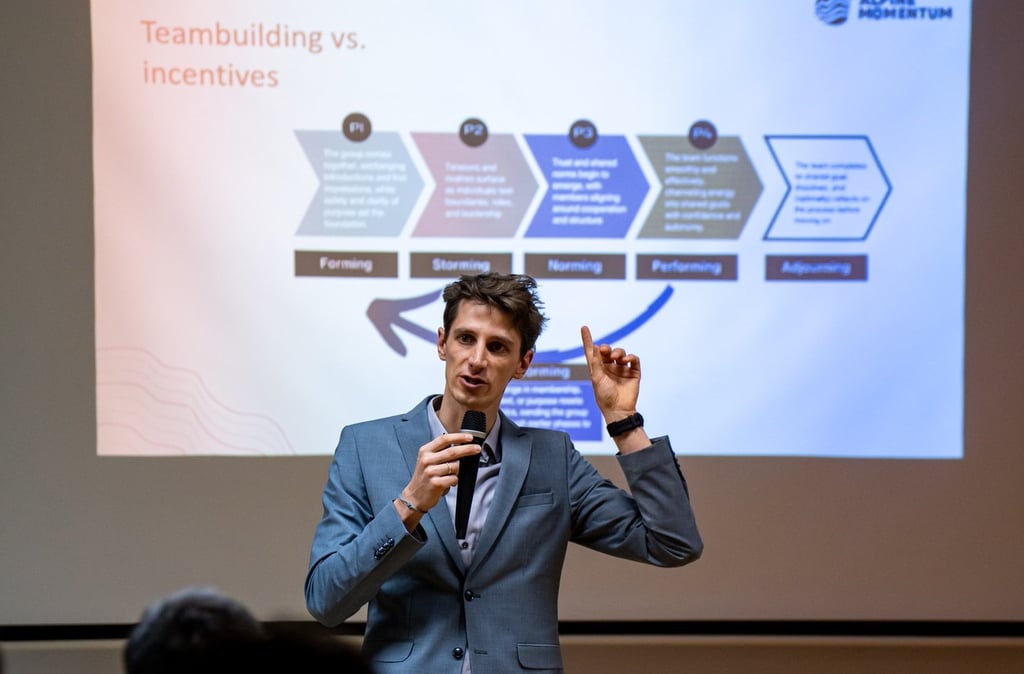
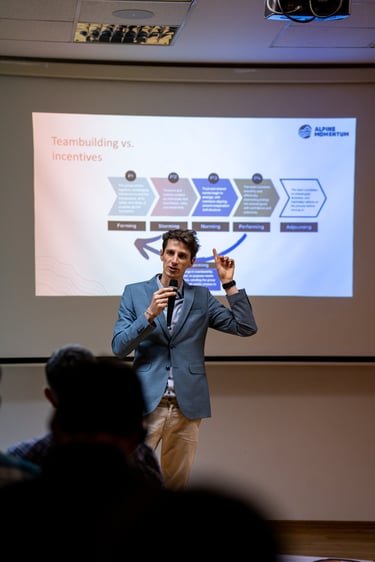
3. Using the Tuckman model as a navigation tool
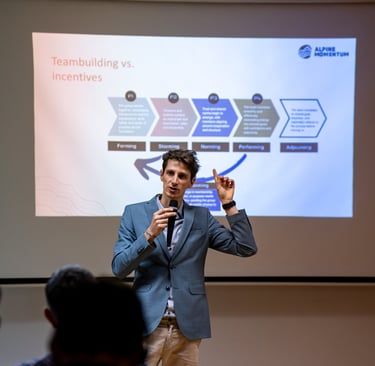
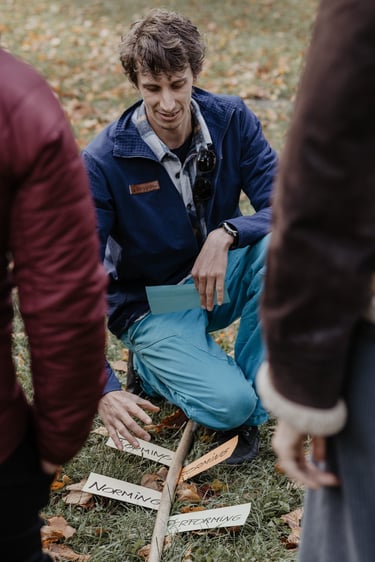
Bruce Tuckman’s model of group development—forming, storming, norming, performing—offers a practical map for choosing the right intervention at the right time.
Forming
Teams are polite, cautious, and often unclear about expectations.
What helps: team building focused on getting to know each other, clarifying shared goals, defining roles, and agreeing on ways of working. This phase is not the end goal; it is about establishing a solid foundation that allows the team to enter storming consciously and constructively.
Incentives at this stage are premature—you would be celebrating something that does not yet exist.Storming
Storming
Differences surface. Friction, frustration, and power dynamics appear.
What helps: facilitated team building that makes tensions discussable, strengthens feedback skills, and improves decision-making under pressure.
Incentives at this stage often feel disconnected or even cynical, as underlying issues remain unaddressed.
Norming
Trust grows. Standards emerge. Alignment improves.
What helps: team building or a carefully framed hybrid approach that reinforces emerging norms and shared responsibility.
Incentive elements can work here as recognition for having worked through difficulty and built cohesion.
Performing
The team operates with autonomy, clarity, and flow.
What helps: incentives are often ideal—celebrating achievement, reinforcing identity, and marking success. Targeted team building or hybrid approaches can still add value by fine-tuning collaboration and sustaining a high level of performance.
More intensive team building is only needed when the team is about to step into a new level of complexity.
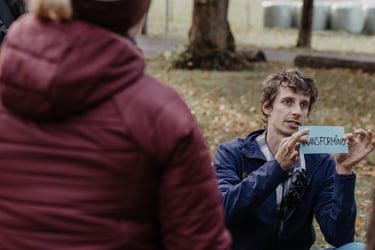
Transforming
The team is undergoing change—new members, new leadership, or a new mandate. As a result, it will move through forming, storming, and norming again before it can return to peak performance.
What helps: a focused team-building intervention can significantly shorten this transition by quickly re-establishing clarity, trust, and shared direction.
Adjourning
The shared goal or reason for the team’s existence has been completed. It is time to separate.
What helps: a meaningful shared experience or moment of closure. This helps acknowledge contribution, preserve relationships, and make the transition feel intentional rather than abrupt
4. When to choose team building
Choose team building when:
roles and responsibilities are unclear
collaboration feels inefficient or draining
people hesitate to speak up or challenge decisions
team composition or leadership has changed
you want behavior to change in a lasting way
Well-designed team building is not about forced vulnerability or endless reflection. It is about creating clarity, shared language, and reliable patterns of interaction—under conditions that make those patterns visible.
Alpine example
A team that consistently hesitates to raise concerns in poor visibility does not need a reward. It needs a setting where communication norms, decision thresholds, and responsibility can be practiced—before conditions become serious.
5. When to choose an incentive event
Choose an incentive when:
clear goals have been achieved
performance deserves recognition
appreciation needs to be expressed on behalf of the organization
retention, loyalty, and pride are strategic priorities
Incentive travel, when clearly framed as a reward rather than a disguised intervention, is a powerful tool for emotional engagement and long-term motivation.
Alpine example
A team that has delivered exceptional results deserves to step out of performance mode, enjoy the mountains, recover, and reconnect—without being asked to “work on themselves.”
6. The Alpine Momentum hybrid—when both can coexis
Team building and incentives can be combined—but only with deliberate design
What works:
explicitly naming which part is celebration and which part is development
keeping development focused and relevant
letting the mountain environment create learning moments naturally
translating insights into a small number of concrete agreements
What fails is ambiguity
In alpine terms: carrying half the rope, half the plan, and half the commitment is not balance—it is exposure.
7. A simple decision framework
Three questions are usually enough:
Are we trying to improve performance, or reward performance?- Improvement points to team building. Reward points to incentive.
Where is this team developmentally? - Early or turbulent phases benefit from team building. Mature, high-performing teams benefit from incentives.
Do we want long-term behavioral change or a meaningful peak experience?- Long-term change requires structure and follow-up. Peak experiences require recognition and narrative.
Closing reflection
In the mountains, good days are rarely accidental. They are the result of intention, timing, route choice, and clear agreements about what the day is for
Team building is preparation and alignment.
Incentives are recognition and celebration.
Both have their place—but only when used deliberately, and never as substitutes for one another
At Alpine Momentum, we design experiences the same way we design alpine days: choose the right tool for the terrain, and the right moment for the move.

HQ
Außertal 36, A-6157 Obernberg
Contact
jef@berggids.be
+43 699 1835 6877
